The Impact of Remote Work on Geographic Pay
In the years since the pandemic, remote work has evolved from an emergency measure to a long-term fixture. Many organizations now manage blended workforces that include fully remote, hybrid, and on-site employees spread across multiple locations. Despite the popularity of flexible work arrangements, ERI’s “Remote Work, AI, and Compensation Best Practices - Spring 2024” survey highlights a possible movement away from fully remote work options in a post-COVID-19 world, with 36% of respondents reporting that, while they are hiring remote workers, it is only under certain circumstances. This may suggest a trend away from hiring remote-only employees to more hybrid roles and flexible work environments that combine remote, hybrid, and onsite work options. As a recent CNBC article asserts, hybrid work options are here to stay amidst the return to office movement, steadily becoming a more common and popular work model that many organizations have adopted.1 While flexible work arrangements may vary, the rapid increase of remote work in the past five years has ultimately shifted geographic pay dynamics, influencing how HR and compensation professionals plan and strategize compensation.
As more organizations manage complex and distributed workforces in which employees work from various locations, geographic pay becomes increasingly relevant for HR and compensation professionals to understand and incorporate into their compensation planning.
Key Considerations for Geographic Pay
When incorporating geographic pay into a compensation plan, HR and compensation analysts must understand that there isn’t a “one-size-fits-all” approach. It is essential that analysts customize compensation approaches to their specific organization’s pay philosophy and expectations. Now, what exactly is geographic pay, and what makes it so essential for organizations to administer?
In short, geographic pay is a method of compensation that sets employee pay against a geographic labor market based on their primary location of work. When administering geographic pay, HR and compensation analysts strive to ensure that employees are paid fairly and competitively in their respective labor markets, while maintaining internal equity and managing organizational costs responsibly.
As HR and compensation analysts calculate geographic pay, it is important to consider a few key points beforehand:
Decide on the data sources: There are multiple sources that HR and compensation analysts can turn to in the process of determining geographic pay. Most used are geographic differential surveys and local salary survey data that capture the cost of labor in specific locations. The cost of living is much less commonly used for geographic pay determinations; typically, it is used for relocation packages as it reflects the supply and demand of goods, housing, and services in a particular area. By contrast, the cost of labor reflects the supply and demand for talent within a specific market.
Evaluate the cost impact: Incorporating geographic pay into a compensation structure can have a significant impact on an organization's overall labor costs. By nature, compensation structures are already so complex. But, as compensation analysts proceed with incorporating geographic pay practices, compensation structures inherently become even more complex to administer. That said, if geographic differentiation is not accounted for carefully, the risk of overpaying in low-cost markets or underpaying in high-cost markets can present long-term financial consequences. Inconsistent and inaccurate pay decisions can lead to either overpaying employees in their geographic market, affecting an organization’s budget, or underpaying employees, negatively impacting a company’s ability to attract, retain, and motivate employees. Despite the additional administrative costs, the overall benefits of effective geographic pay differentiation are clear.
Establish hybrid and mobility policies: It is important for organizations to develop structured hybrid and mobility practices, defining clear standards and policies for how compensation responds to changes in where and how employees work. HR and compensation analysts must decide how to approach pay models in a hybrid setting and explicitly outline mobility categories, such as “permanent remote employee,” “employee-initiated relocation,” “employer-driven relocation,” or “hybrid employee assigned to a specific office.” Furthermore, analysts should specify the pay rules for each category, such as which location is used to determine geographic differentials, when adjustments take effect, etc. Establishing these policies helps HR and compensation analysts work from a standardized framework when evaluating approved relocation requests or handling pay for new employees with flexible work arrangements, mitigating potential pay inequities or inconsistencies.
Standard Geographic Pay Methodologies
In general, there are three approaches to calculating geographic pay: city, state, and region. Although there is a national approach, this is mainly used to determine executive compensation, as these top positions are usually recruited at the national level. Each approach to geographic pay has benefits and disadvantages, with some approaches better suited for particular circumstances.
Region: Although a regional approach provides simplicity in managing geographic pay, there are potential issues. When setting geographic pay by region, analysts may have to combine larger metropolitan areas with much smaller cities. This runs the risk of overpaying or underpaying in competitive locations, creating potential problems with external equity. Furthermore, one of the challenges in a regional approach is to create appropriate regional breakouts that reflect differences in the competitive marketplace, such as “Pacific Northwest,” “Midwest,” and “New England.” More often than not, compensation analysts would have to break out specific high-cost locations, such as San Francisco or New York City, even further to account for their regional weight in pay.
State: While some organizations may recruit in-state, the state approach is also rife with potential challenges. HR and compensation analysts run a similar risk to the regional approach, in which organizations may overpay or underpay in competitive locations. In a diverse state, such as California, labor markets vary considerably. Higher-priced markets in thriving cities, such as San Francisco, would be treated differently from lower-priced labor markets, like Bakersfield or Redding. The state approach could ultimately produce issues in pay, where those living in metropolitan areas may be potentially underpaid, while employees in smaller areas may experience inflated compensation.
City: The city-specific approach is considered to be the best method to capture accurate and consistent pay for an organization with a limited number of offices spread across the country. This approach ensures that organizations are not underpaying or overpaying employees, acknowledging the considerable differences in labor markets between higher-cost metropolitan cities and smaller areas. The city-specific approach also allows organizations to look at granular data, such as locations within a commuting distance from an office (approximately one hour) or specific neighborhoods in a metropolitan area.
For a more in-depth discussion of geographic pay practices, dive into ERI’s white paper, “How to Implement Geographic Pay Best Practices.”
Our Geographic Assessor – Your Compensation Solution
Although return-to-office initiatives have popularized flexible work arrangements, such as hybrid work models over remote-only work models, the impact of remote pay practices is here to stay, propelling organizations to rethink their geographic pay philosophies.
The necessity for current and reliable data and solutions to set geographic pay is an ongoing concern for HR and compensation analysts. Our Geographic Assessor stands out as an invaluable resource to set accurate geographic pay for remote, hybrid, and on-site employees. In our Geographic Assessor, experts can efficiently handle a wide variety of tasks, such as analyzing the cost of labor to determine and calculate geographic salary structures for multiple branch offices.
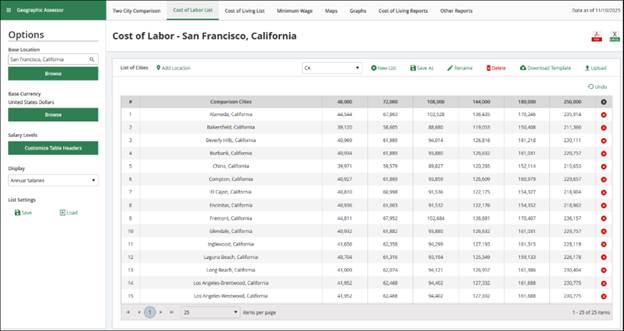
Figure 1. Using the Geographic Assessor, subscribers can analyze the cost of labor in multiple locations for up to 20 salary levels to create data-informed geographic salary structures.
The Geographic Assessor provides a granular approach to your data, designed to help you answer questions like these: “How does location change benchmarked pay?” or “If we expand into new markets, will it cost our company more or save our company on labor costs?” Essentially, the Geographic Assessor can answer any location-related pay question that you may have beyond job-level salary benchmarking, which is answered by Salary Assessor results.
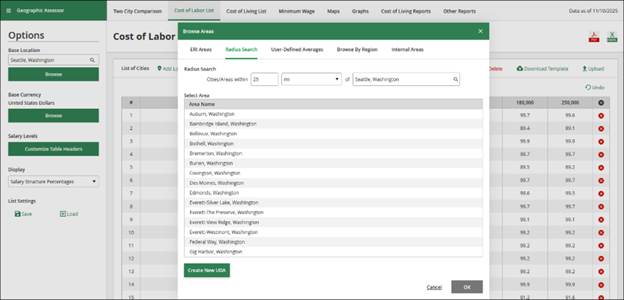
Figure 2. Using the radius search in ERI SalaryExpert’s Geographic Assessor, subscribers can view all areas within a selected distance from the specified city.
Our Geographic Assessor ensures that your process for making geographic pay decisions becomes strategic and effective. With accurate data and flexible features, you can accomplish myriad tasks with ease, such as comparing geographic pay differentials, comparing the cost of living between two or more areas, and reviewing current and upcoming minimum wage rates. Interested in supercharging the way you approach compensation management? Try a free demo here!
Sources:
- Duarte, Valentina, and Jennifer Liu. “5 Years into the Remote Work Boom, the Return-To-Office Push Is Stronger than Ever—Here’s Why.” CNBC, 23 Mar. 2025, https://www.cnbc.com/2025/03/23/5-years-into-the-remote-work-boom-the-return-to-office-push-is-stronger-than-everheres-why.html. Accessed 7 Nov, 2025.