How to Create a Global Compensation Strategy
Organizations that expand beyond their local markets across countries and continents can grow their businesses significantly. However, one of the biggest challenges when expanding is developing an international compensation plan that balances pay equity, competitiveness, and local compliance. By creating an effective global compensation strategy that integrates diverse salary structures, cultural expectations, legal frameworks, and business goals, multinational organizations can successfully manage compensation strategies across different countries
What Is a Global Compensation Strategy?
A global compensation strategy is a comprehensive approach to determining how employees will be compensated in different countries while maintaining internal and external equity, as well as competitiveness. It involves setting salary ranges, benefits, bonuses, and other rewards that account for each region's varying economic conditions, legal requirements, and cultural expectations.
A global compensation strategy can help organizations achieve these goals:
- Attract and retain talent: A well-planned global compensation strategy ensures that organizations offer competitive salaries and benefits across all locations, which can help you attract ideal candidates and retain employees in a global market.
- Maintain pay equity: Pay equity fosters an inclusive environment and ensures that employees are compensated fairly based on their role and geography.
- Stay compliant: Stringent global compensation practices help ensure that your organization adheres to local labor laws, tax regulations, and compensation standards across various regions. Stay compliant with access to current North American minimum wage data for over 9,000 locations in our Geographic Assessor.
How to Create a Global Compensation Strategy
A global compensation strategy is a foundation for deciding how to compensate and reward employees in international markets. To adopt pay equity for employees with different country standards, consider these steps:
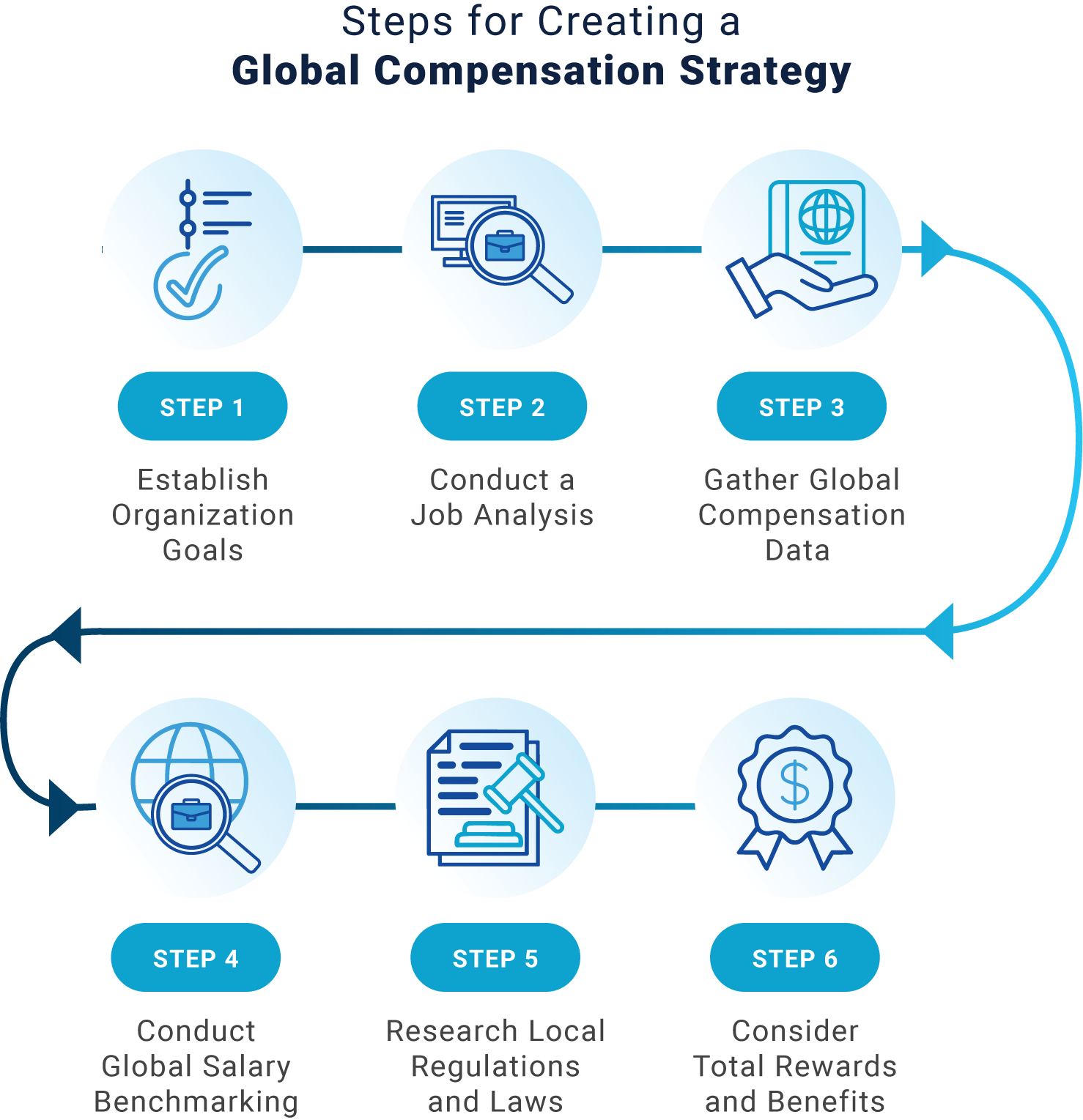
1. Establish Organization Goals
Whether your organization is looking to expand to an international market or reevaluate its current global compensation strategy, start by reviewing its overall goals. Identifying business goals will guide your decisions throughout the global compensation planning process. For instance, one strategy could include providing employees with a competitive incentives plan alongside a wellness plan to promote work-life balance.
2. Conduct a Job Analysis
Before setting salaries, perform a thorough job analysis of organizational roles. This process involves defining each position's scope, responsibilities, and skill requirements globally. This will ensure that roles in various locations are comparable in terms of job function and responsibilities, even if they have different titles or local interpretations. Develop clear job descriptions that can be applied across regions while allowing for local variations, where needed. Our Occupational Assessor guides you through job analysis using the PAQ, a structured job analysis questionnaire that aids in conducting a quantified analysis of a given job. This job analysis tool can be used to compare similar positions in your organization.
3. Gather Global Compensation Data
Compile and analyze global compensation data, including the total compensation packages offered in various regions, factoring in base salary, bonus, incentives, and benefits offerings. Consider how currency fluctuations, local market competitiveness, inflation rates, cost of living, and economic stability across regions can impact global salary structures. By adjusting for these variables, you can ensure fair and equitable compensation. You can use our Assessor Platform to get the data you need to plan compensation around the world. This salary planning platform compares jobs from more than 9,400 locations around the globe.
4. Conduct Global Salary Benchmarking
Global salary benchmarking compares an organization’s pay structure with the market rates in different countries. This ensures that you offer competitive salaries without over- or under-paying employees in any region.
Conduct global salary benchmarking that includes these steps:
- Define comparable roles: Since job titles may vary across regions, it is important to identify comparable roles by performing a job matching process that determines similar roles by job function and responsibility.
- Use multiple data sources: Gather data from reputable salary surveys and databases to account for regional variations. Our Assessor Platform offers an extensive salary survey database to help organizations generate global salary comparisons quickly and accurately. Use our Global Salary Calculator database to benchmark jobs based on the desired competitive market location, whether it is national, regional, or state.
- Account for cost-of-living adjustments: In international relocations, salaries may be adjusted, often using relocation bonuses, to reflect the local cost of living, especially in regions with significant variations. Using our cost-of-living comparison calculator, a software engineer making $150,000 in San Francisco, California, would only need to make $64,260 (or €64,412) to achieve a similar standard of living in Albano Laziale, Italy, where the cost of living is significantly lower.

6. Consider Total Rewards and Benefits
A well-rounded global compensation and benefits package includes both direct pay (e.g., salary and bonuses) and indirect rewards (e.g., health care benefits, retirement plans, and paid time off) based on the country in which the employee is located. For example, in Europe, you might need to offer substantial pension benefits, whereas, in the U.S., more flexible retirement options, such as 401(k) plans, are more common. While benefits should reflect local expectations, maintain a consistent overarching benefits philosophy that ties into your organization’s budget, culture, and values.
Why Use ERI SalaryExpert’s Assessor Platform?
Implementing a global compensation strategy manually can be highly time-consuming and prone to errors, especially when dealing with complex datasets and regulatory requirements. Our Assessor Platform includes many tools to assist with this process, ensuring accuracy and saving valuable time.
The Assessor Platform includes these useful tools:
- Employee cost calculator: Benchmark base salary, incentive, long-term incentive, and total cash at various percentiles.
- Customizable inputs: Customize compensation rates based on experience, organization size, shift differentials, skills, education, certifications, region, and other factors to ensure that the calculation reflects your specific circumstances.
- Reporting and analytics: Generate detailed reports and analytics to understand market trends, demonstrate budget impacts, and forecast future costs.
- Scenario planning: Run various scenarios to understand how changes in your total compensation package may impact overall employee costs. You can export unlimited salary reports with data for over 39,800 jobs, 1,100 industries, and 10,400 global locations.
With the right global compensation management software, you can reduce administrative overhead, maintain compliance, and ensure that your global compensation strategy is both competitive and equitable in all markets.