Job Evaluation Guide: Methods, Best Practices & Process
Job evaluation is a key step in the development of a formal compensation program and can have a significant impact on an organization’s success. Although HR and compensation professionals typically rely on market-based pay systems to determine compensation, job evaluation is another important resource in an analyst’s toolkit, particularly when the goal is achieving internal pay equity. A key benefit of job content evaluation is internal consistency and organizational alignment. This not only helps to control labor costs but also ensures fairness and equity within an organization.
What Is Job Evaluation?
Job evaluation is a formal and systematic process for determining the relative value of jobs in an organization based on job content. The result of a formal job evaluation process will be a job worth hierarchy for an organization. It is important to note that job evaluation is concerned with job content, not people.
Why Is Job Evaluation Important?
Effective job evaluation provides a strong foundation for staffing, total rewards, talent development, succession planning, and organization design. It provides a common language for an organization’s job hierarchy and can improve overall organizational efficiency. Job evaluation develops a common basis for determining salary grades, bands, or job evaluation points, which provide consistency in matching jobs to local markets for competitive compensation.
Here are some significant benefits of job evaluation:
- Internal consistency
- Organizational alignment
- Control of labor costs
- Fairness and equity
- Job worth hierarchy
- Market competitiveness
These are some of the most common uses of job evaluation:
- Establishes a fair and equitable distribution of the budget allocated to labor costs
- Ensures that new hires are hired at appropriate starting rates within an organization
- Supports the succession planning process
- Aids in the development of career ladders
- Provides the basis for determining eligibility for other total reward programs (e.g., short- and long-term incentives, benefits, etc.)
- Provides the structure for determining fair and equitable job titling
- Provides a methodology for classifying new or changed jobs
- Reduces grievances by establishing agreed-upon compensable factors that can be used to resolve internal pay equity disputed
Given these positive impacts on business outcomes, job evaluation is a valuable process for organizations of all shapes and sizes.
Job Evaluation Methods and Techniques
There are five main types of job evaluation programs:
- Job Ranking: Jobs are compared using a single global factor that combines all parts of the job.
- Job Classification: This method defines categories of jobs and slots jobs into these classes.
- Factor Comparison: Job-to-job comparisons are made using several specific factors.
- Point Factor: Jobs are compared using rating scales of specific factors.
- Market Pricing: The value of each job is determined through an analysis of the external job market, as reported through salary surveys.
Which Job Evaluation Method Is Best?
The choice of which job evaluation technique to use is largely based on the particular circumstances or characteristics of the organization, such as organization size, as well as its specific priorities, such as time, expense, employee acceptance, or legal defensibility. For example, market pricing is the most prevalent job evaluation program today, with approximately 80% of organizations using this technique as their primary job evaluation methodology, so it is widely understood and accepted. Job ranking, on the other hand, is the simplest job evaluation method to administer. It is easy to explain, inexpensive, and less time consuming than other methods, but ranking decisions may be subjective and more difficult to defend in courts of law, with the possibility of inconsistencies among organization units. Factor comparison is cost-effective and fair but not widely used. That said, factor comparison may be particularly valuable for the evaluation of hourly jobs in the manufacturing industry. The point factor technique tends to be costly, complex, and complicated to explain, though it produces high-quality results and has been successfully defended in legal scenarios. Many turn to the point factor method for minimizing pay equity issues.
A Closer Look at Three Job Evaluation Methodologies
Let’s focus next on three of the most common job evaluation techniques in use today: job ranking, point factor, and market pricing.
JOB RANKING
In whole job ranking, jobs are ranked from highest to lowest in importance. Job ranking entails identifying the most important job in the organization, then the next most important job, and so on until you have reached the least important job in the hierarchy. This approach seems to work best for small companies with few jobs to rank, though some large organizations have employed this simple technique.
For example, the top of a job ranking hierarchy may look like this:
- CEO
- Vice President
- Operations Director
- Operations Manager
- Senior Engineer
- Engineer
- Associate Engineer
The primary disadvantage of job ranking is its use of adjacent ranks, suggesting that there are equal differences between jobs, which is exceedingly unlikely. Job ranking is also dependent on first attaining accurate job descriptions for all the jobs in the organization, which may be challenging for large organizations with many jobs or jobs that change frequently over time. What’s more, ranking of whole jobs may result in different bases of comparison among evaluators who may be influenced unconsciously by current compensation rates, perceived competence of job incumbents, or the prestige of certain jobs. Evaluators can overcome this challenge by selecting and defining one or more compensable factors for use as the basis for job comparison. But, even then, compensable factor definitions are often so general that rankings are highly subjective.
Job Ranking Steps
To successfully implement job ranking given the challenges mentioned above, these steps are recommended:
- Obtain Job Information
The first step in job evaluation is job analysis, which involves gathering accurate job information and writing detailed job descriptions.
2. Choose Evaluators
Next, select evaluators and train them in the job evaluation process, though job ranking requires less training than other methods. It is important to select evaluators who are unbiased and have some knowledge of the jobs and functions in the organization. If ranking all jobs in the organization, you might start with the executive team and then rank important benchmark jobs, followed by all other jobs that can be evaluated based on this hierarchy. Another approach is to rank jobs by department and then compile the rankings.
3. Select Compensable Factor(s)
It is essential to concretely define the compensable factor(s) used in job ranking so that all evaluators use the same attributes. Define compensable factors, even broad terms like job difficulty or importance, in operational terms. Make sure that all evaluators clearly understand the factor(s) being used to compare and rank jobs.
4. Rank Jobs
There are three typical ways to complete job rankings:
- Straight ranking – This involves ordering cards (one for each job) that include job titles or short job briefs, with detailed job descriptions on hand if further information is needed.
- Alternation ranking – Evaluators are given a form on which a list of job titles to be ranked are recorded at the left and an equal number of blanks appear at the right. The evaluators are asked to record at the top of the right-hand column the job title they consider the highest and then cross out that title from the left-hand list. Then they record the lowest job in the bottom blank and the remaining jobs in between, eliminating the job titles from the left-hand list as they proceed.
- Paired comparison – In this method, evaluators compare all possible pairs of jobs. One way to do this is with a pack of cards on which job titles have been recorded, as in straight ranking. Evaluators compare each pair of jobs at least once. The card of the job judged to be higher is checked after each comparison. After all comparisons have been made, the evaluators list the jobs, starting with the job with the most check marks and ending with the job with the fewest marks. Microsoft Excel can also be used for paired comparisons.
Keep in mind that straight ranking works best for a limited number of jobs, say 20 or fewer, whereas alternation ranking or paired comparison tend to yield more consistent results.
5. Combine Ratings
Finally, it is best to have several evaluators rank the jobs independently. These rankings are then averaged, producing a composite ranking that is more accurate than an individual ranking alone.
Although job ranking is a simple approach with some disadvantages described above, it remains a valid option if more sophisticated job evaluation techniques are not being used.
POINT FACTOR
At the core of the point factor method is the need to place jobs in a job hierarchy based on their worth to the organization. To do this using the point factor method, each job is rated using compensable factors and sub-factors that are assigned points based on weighting.
Although designing a point factor plan can be time-consuming, the end result is objective and consistent, contributing to a fair and equitable hierarchy of jobs that is legally defensible. HR and compensation professionals can choose from an array of point plans for purchase in the marketplace, with many turning to the Korn Ferry Hay Guide Chart - Profile Method as a popular point factor job evaluation plan used extensively in private and public sectors.
How to Design a Point Factor Plan
The point system technique involves rating each job based on compensable factors. The scores given for each factor are then added to obtain a point total for a job. As with the job ranking method, this process begins with job analysis (gathering accurate job information and writing detailed job descriptions for each role being analyzed) and selecting evaluators (including training and guidance in the point factor process). Building a point factor plan entails these subsequent steps, which will be discussed below:
- Select compensable factors
- Determine factor and sub-factor weighting
- Set levels
- Score a job
Choose Compensable Factors
The process of building a point factor methodology job evaluation begins with rating each job based on compensable factors. When choosing compensable factors, consider whether they have these important characteristics:
- They must be present in all jobs.
- They need to be definable and measurable.
- The factor must vary in degree so that it has different levels. A factor found in equal amounts in all jobs would be worthless as a basis of comparison.
- If two or more factors are chosen, then they should not overlap in meaning. If they do overlap, double weight may be given to one factor.
- Compensable factors must be demonstrably derived from the work performed and observable in the jobs. Compensable factors can be thought of as the job-related contributions of employees. Documentation of the work-relatedness of factors comes from job descriptions. Such documentation provides evidence against allegations of illegal pay discrimination, as well as answers to employees, managers, and other stakeholders who may question the differences among jobs.
- Compensable factors need to fit the organization. Companies design jobs to meet their goals and fit their organizational culture, use of technology, and values.
Here are some widely accepted basic compensable factors, though organizations may use others:
- Skill/Qualifications
- Responsibility
- Effort
- Working Conditions
Typically, a job evaluation plan has three to five basic compensable factors, such as those listed above. These factors may be further subdivided into 10 to 16 sub-factors that fit the organization. Consider these examples:
Skill/Qualifications
- Experience
- Knowledge or Education Level
- Ability
Effort
- Mental
- Physical
- Visual
Responsibilities
- Budgeting
- Safety
- Supervisory/Management
- Independent Work
- Difficulty of Tasks
- Interaction
Working Conditions
- Physical Environment
- Psychological Climate
Each factor and sub-factor must have a carefully written detailed definition. These descriptions will be referred to by evaluators frequently, so they are critical. Each sub-factor is then assigned levels, also known as degrees. There may be two to nine levels, but four to six is typical. Each level must also have a carefully written definition.
Determine Factor and Sub-factor Weighting
After selecting compensable factors, the next step involves weighting the factors and sub-factors given some may be more important than others. One method for assigning correct weights is by committee. In this approach, a committee made up of members who are familiar with the jobs under review will determine weighting, as follows:
- Carefully study factor, sub-factor, and level definitions
- Individually rank the factors and sub-factors in order of importance
- Reach agreement on each ranking
- Individually distribute a weighting adding up to 100% among the factors
- Reach agreement on each weighting
The result is a set of factor and sub-factor weights that reflect the judgment of organization members, which contributes to acceptance of the plan.
The next step is to assign points to the factors and sub-factors based on the established weightings. It is typical to use a total of 1,000 points. A table can be created displaying the weightings and corresponding points, which will be used to score all the applicable jobs in the organization.
Set Levels
Once the factor and sub-factor weightings and points have been decided, the next step is to set levels for each sub-factor, which may be established by either arithmetic or geometric progression:
- Arithmetic Progression – Increases are in equal numbers of points from the lowest to the highest level. This approach best supports pay equity.
- Geometric Progression – Increases are by equal percentages. Point differences increase between each level starting at the lowest level.
For example, a committee decides that the total points possible in the plan are 1,000. So, a sub-factor weighted at 16% carries 160 points (0.16 x 1,000 = 160). If the sub-factor has 4 levels, then the points assigned for level 3 would be 120 (160/4 = 40, 40 x 3 = 120).
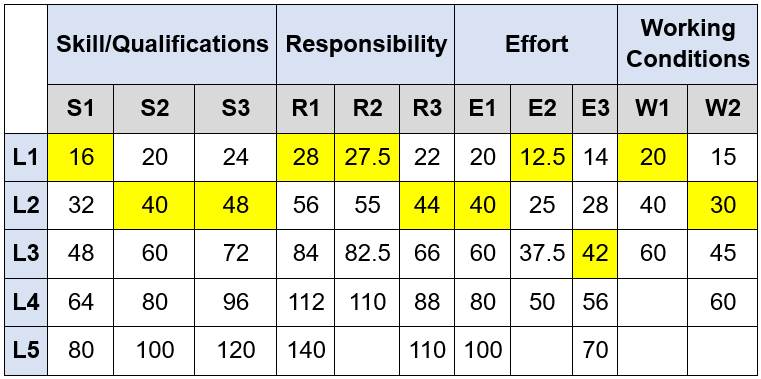
After levels have been determined, it is helpful to build a single table with levels, factors, and sub-factors that can be used to score all the jobs in the organization, as in the example below:
Score Job
Now your trained job evaluators can begin evaluating the jobs. Top jobs are usually evaluated first, then benchmark jobs, and, finally, the remaining jobs.
Consider the example of an Accounts Payable Assistant job that is scored in the table above for each sub-factor and appropriate level. The points are highlighted in yellow, yielding a total score for this job of 348.
When all jobs are scored, jobs with scores within given intervals are grouped together. There should be no gaps between intervals, and they should not overlap. Beginning with 1,000 total points, the organization decides that there should be 10 pay grades.
Since the total points for all Level 1 sub-factors is 219, Grade 1 will start at 200, with 800 points being distributed between 10 grades. The grades do not need to have exactly the same intervals but, for this example, they will be distributed evenly. Higher grades may have wider intervals.

So, the Accounts Payable Assistant job in this example would be assigned to Grade 2.
The Pros and Cons of the Point Factor Method
Although the point factor method is generally considered a very accurate technique to create a job hierarchy, it may not be appropriate for all organizations:
Advantages
- Stability – Once the rating scales are developed, they may be used for a considerable period. Only major changes in the organization require a change in scales; job changes do not require changing scales.
- Accuracy – Point factor plans increase in accuracy and consistency with use.
- Acceptance – Given the compensable factors have been judged to be relevant and important to the organization, employees are likely to accept the results.
- Many uses – Point factor plans facilitate the development of job classes or grades, as well as job pricing and the design of pay structures.
Disadvantages
- Complexity – Compensable factors are not universal, so these must be reviewed and selected, preferably by members of a committee familiar with the jobs. Then level statements must be devised for each of the sub-factors chosen.
- Time and expense – Point factor plans take significant time to create and implement. Each job must be rated, usually by several job evaluators. Then, the results must be summarized and accepted. Considerable administrative work is involved in recording and collating all these ratings. If an organization chooses to avoid this time-consuming process by purchasing a ready-made plan, then it needs to factor in that additional expense.
MARKET PRICING
Market pricing is a job evaluation methodology that creates a job-worth hierarchy based on the “going rate” for benchmark jobs in the external marketplace relevant to the organization. All other jobs are “slotted” into the hierarchy based on whole-job comparison. Market pricing is a widely accepted and practical approach using credible and reliable salary survey results to add validity to the market pricing process.
In market pricing, the hierarchy of an organization is established based on the external marketplace first and internal equity second. In general, other job evaluation techniques align the jobs based on job content and internal equity first and utilize the external marketplace second.
Market Pricing Steps
Here are the key steps to market price compensation in an organization:
- Collect three or more salary surveys representing your organization
- Identify benchmark jobs and match them to the external marketplace
- Summarize market data and analysis for the benchmark jobs
- Develop a salary structure based on market data for the benchmark jobs
- Slot remaining non-benchmark jobs into a salary structure
- Develop a compa-ratio report comparing employees’ pay to the midpoints of the recommended salary structure with related costs
- Obtain top management approval
Market Pricing Guidelines
Consider these helpful guidelines when using market pricing to create the foundation for a sound salary structure:
- Use multiple salary surveys when creating your external market database, ideally three or more salary surveys.
- Attempt to match at least 70% of job content for each benchmark job to the survey job descriptions. The stronger the match, the more reliable the survey results.
- Attempt to match at least 50% of your benchmark jobs to the external marketplace. Try to match as many benchmark jobs as possible to ensure greater validity in your salary structure.
- Obtain surveys with credible and relevant survey participants closely matching your organization.
- Use surveys which allow you to filter the data by number of employees, location, industry, revenue, and years of experience or level. This will ensure closer matches to your organization’s jobs, labor market, and size.
For more detailed information about market pricing, download ERI SalaryExpert’s white paper, “Pure Market Pricing – A Salary Structure Design for Today’s Challenging Labor Market.”
Evaluating the Results Your Job Evaluation Plan
After you have created a job evaluation plan, top management should participate in approving the results and hierarchy of jobs. Organizational acceptance of the hierarchy of jobs is important for transparency in the compensation program, as well as the organization’s overall success.
Here are three important considerations for a job evaluation plan:
- A job evaluation program should always include a formal appeals process with management approval to ensure appropriate due diligence in the process and employee surveys to identify employee satisfaction with the results of the job evaluation program. For example, when surveying employees, consider asking, “Is the internal hierarchy of jobs fair and equitable in the organization?”
- Evaluate the reliability of the job evaluation results by looking for these criteria:
- Top management support and approvals
- Carefully defined benchmark jobs
- Carefully selected, unbiased job evaluators
- Quality job descriptions
- Well-trained job evaluators
- Knowledge of jobs
- Consensus decisions by a job evaluation committee, if used
- Use of a formal appeals process
- Consider the costs, including increased labor costs, of the job evaluation plan’s design, administration, and installation, which will vary with the type of plan, the time spent by organization members, and consulting fees (if applicable).
The choice of which job evaluation method to use is particular to each organization’s characteristics and objectives. Whether using a simple job ranking approach in a small organization or a more complex point factor plan, the result will be a job worth hierarchy used by the organization for an array of purposes. Job evaluation is a critical step in the development of a formal compensation program with a significant impact on business success, so it is important to consider this process carefully. When successfully designed and implemented, a job evaluation program will yield both internal consistency and organizational alignment, helping to ensure not only the control of labor costs but also fairness and equity within an organization.
For further information about designing a job evaluation program, ERI SalaryExpert provides these two useful white papers: “How to Design a Job Evaluation Program” and “How to Conduct a Job Evaluation.”
To gain a deeper understanding of job evaluation, turn to ERI’s Distance Learning Center, which provides a detailed course on this topic, “Using Job Evaluation in Your Organization,” in addition to myriad other free HR training courses available at www.erieri.com/dlc/courses.