By moving from ZIP code search methods to coordinate-based precision, users can modernize their approach to labor compliance and build a system that scales reliably with growth.
Minimum Wage and Geocoding
One of the challenges of salary administration is tracking and updating minimum wages. With many branch offices in different jurisdictions, this can pose challenges to tracking wages efficiently. Having a reliable method to determine the appropriate wage is not just a matter of efficiency, it is essential for compliance and fairness.
Why Is Minimum Wage by ZIP Code Not the Most Accurate Method?
At first glance, ZIP codes may seem like an easy shortcut when classifying locations in the U.S. for minimum wage. After all, almost every business and household has one, and they are familiar to employers. However, ZIP codes were designed for mail delivery, not for defining legal or jurisdictional boundaries. This means that a ZIP code can overlap across multiple cities, counties, or even states. Consequently, when relying on ZIP codes alone, there is a significant risk because the boundaries that they follow do not necessarily match the laws that govern wages.
What Is Geocoding and How Is It Used to Determine Minimum Wage?
An alternate way of reporting minimum wage jurisdictions is by geocoding using latitude and longitude. Geocoding allows users to pinpoint locations by latitude and longitude within a drawn city, county, or state boundary. This method bypasses the complexities of classifying minimum wage by ZIP codes, which do not always align one-to-one with boundary lines.
Geocoding solves this problem by offering a more precise approach. Using latitude and longitude coordinates, an individual can identify the exact point of a workplace address and determine the jurisdiction into which it falls. These coordinates are then matched against official boundary shapefiles of state, county, and municipal lines. Due to boundaries being drawn to reflect how governments actually legislate minimum wages, this method ensures that employees are classified under the correct rules.
For example, imagine an office building located on the corner of two busy streets in a large metropolitan area. With geocoding, the building’s address can be translated into exact coordinates, which are then matched to the city’s official wage boundary. The system leaves no doubt about which rules apply, even when the office is near the edge of another jurisdiction.
Geocode vs. ZIP Code Example
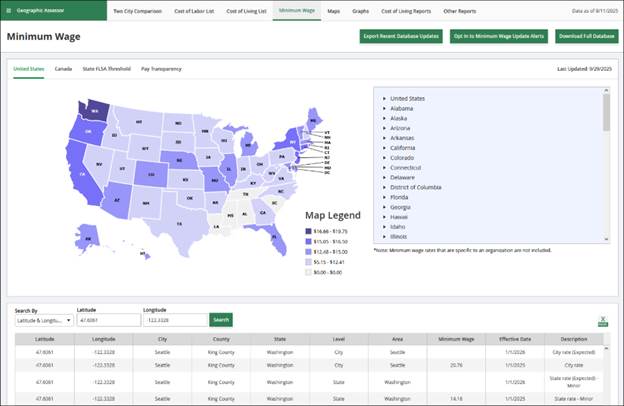
In a real-world scenario, 47.6061, -122.3328 is in downtown Seattle. Just a few miles on either side of it and within the same ZIP code, a business would be governed by different wage rules. If ZIP code were used in this example, it could not distinguish between state, county, and city minimum wage rates because of the broad ZIP code crossing multiple city limit boundary lines. Geocoding provides the exact location and precision that solves the tricky situation of odd serpentine boundary shapes.
Additionally, consider an employee who works remotely in a rural area. Even if their home is far from a town, geocoding pinpoints the exact coordinates and identifies whether the worker falls under county or state jurisdiction. The employer does not need to rely on guesswork. Compliance is ensured through precision.
Geocoding in Minimum Wage Resources
ERI’s Geographic Assessor provides both ZIP code and latitude/longitude search functions to perform a minimum wage check. To search for locations using geocoding in our minimum wage database, simply select the Latitude & Longitude option in the drop-down menu at the bottom-left corner of the Minimum Wage page. Once selected, enter values for Latitude and Longitude and then click Search. The corresponding minimum wage results will be displayed in the table below.