Skill-Based Pay: Why Expertise Should Drive Compensation
There are multiple factors to consider when administering any compensation system. The requirements of a job vary from organization to organization, and the employees that fill those jobs vary in experience, as well. When accurate market pricing is key to establishing pay for individual candidates, the question comes to mind – how should you approach pay when it comes to highly skilled employees?
Myriad factors can impact the acquisition of skills, such as new technology, the incorporation of AI, or circumstances that prompt an increase in workload or oversight within a position. Adopting a skill-based pay system allows organizations to compensate employees for the expertise that they bring to the job and also potentially motivate employees to upskill.
In this article, we will discuss the following issues related to skill-based compensation:
- The merits of implementing skill-based pay
- An overview of popular skills
- Best practices to consider when implementing pay premiums for skills
What Is Skill-based Pay and Why Does It Matter?
Skill-based pay is a system that compensates employees with additional pay for an employee's mastery of skills, knowledge, and/or competencies. Employees acquire these skills formally or informally, and there is proof of observable expertise in performing tasks. For example, a skill-based pay system might reward employees with desired skills, such as being bilingual in a customer service role. Another case would be rewarding employees who have learned additional or high-level job skills through formal accreditation.
The Advantages of Skill-based Pay
Prioritizing continuous professional development and learning opportunities is not only an incentive for an organization's employees but also proves to be part of a well-rounded and strategic compensation plan. Here are some benefits that skill-based pay systems can produce:
- High employee retention rates and engagement: When organizations demonstrate an investment in employee training and continuous learning, they have a higher chance of retaining their workforce. With the bonus of professional development, existing employees can work towards their professional goals, while staying engaged and performing effectively.
- Reduces hiring costs: As employees develop new skills, employers may be able to reduce hiring costs. Instead of hiring externally, which costs time, money, and training, skill-based pay minimizes those potential costs by compensating current employees who already have those skills and incentivizing existing employees to obtain additional job skills. Essentially, current employees take on the tasks that may have required additional hires.
- Aligns employee growth with company goals: A skill-based pay structure will help align employee growth with company goals. Organizations can focus on industry-specific skills, offering programs that promote employee effectiveness and ensure the company stays competitive.
- Increased productivity and efficiency: Skilled employees will perform productively and efficiently, contributing their efforts to areas that require complexity and expertise.
- Attracts talent with continuous learning and professional development: An organization that supplements their compensation strategy with skill-based pay premiums will attract and retain potential talent. High performing employees consistently look for areas to enrich their skills and knowledge, becoming a boon to their employers.
Including skill-based pay premiums in your market pricing is a valuable strategy for HR and compensation professionals to accurately benchmark positions requiring special skills and compensate employees precisely. Although drawbacks could include more administrative time and expenses, such as the need for more individualized assessment to adjust pay or ensuring budgets allow for the necessary pay increases. However, organizations should find that investing in this employee compensation component leads to worthwhile talent and career development and, ultimately, reduced hiring costs and improved productivity.
ERI SalaryExpert’s Overview of Popular Skills
Using ERI SalaryExperts’s extensive database of skills, a list of “hot skills” is provided below, detailing the skills most selected by ERI SalaryExpert subscribers. These skills are divided into two sections, distinguishing technical skills and soft skills. Technical skills refer to quantifiable, job-specific abilities and knowledge, such as cloud computing or coding. In contrast, soft skills are based on more interpersonal attributes that often influence how a person interacts with coworkers and peers, such as communication or coordinating activities within an organization. Both technical and soft skills are critical to ensure employees perform successfully and productively.
| Technical Skills | Soft Skills |
| Strategic Planning | Coordinates Activities |
| Project Management | Organizational Management |
| Data Analysis | Advises Management |
| Python | Implements Goals |
| Business Administration | Effective Communication |
| Business Analysis | Provides Leadership |
| Problem Analysis | Assists Customers |
| Employee Relations | Assesses Data |
| Bilingual | Implements Policies |
| Change Management | Customer Service |
Figure 1. The top technical and soft skills most selected by ERI SalaryExpert subscribers (data as of July 2025)
A skill may be in demand for several reasons, such as technological advancements or evolving business needs. Take, for example, the top five technical skills listed above. Skills such as strategic planning, data analysis, Python, business administration, and business analysis all require critical thinking and an expert level of knowledge in computer programs and technology. Employees who acquire these skills and demonstrate their use will often warrant a skill-based pay premium.
It is important to note that, when using ERI SalaryExpert's Assessor Platform for skill-based pay premiums, our database treats skills and certifications as distinct from one another. To explore our library of skills and certifications, log in to the Assessor Platform and view the Data Availability resources cataloging all of the skills and certifications available in ERI SalaryExpert’s database.
Best Practices for Implementing Pay Premiums for Job Skills
HR and compensation professionals are tasked with accurately benchmarking their internal jobs and creating pay structures. While survey job averages provide accurate benchmarks, in order for an organization and its pay structure to maintain long-term sustainability, it is beneficial to consider other pay components, such as skill-based pay premiums, in addition to average base salary information. Including the premium market rates for skills, reflecting how a job truly functions or how an employee operates within an organization, will provide the most accurate alignment to the market.
Consider these key factors below to ensure the successful implementation and administration of skill-based pay premiums:
- Develop a compensation plan that clearly defines a skill-based pay structure: When developing a compensation plan, it is always important to be meticulous, clearly defining every step and strategy planned. That goes for implementing skill-based pay premiums, as well. For instance, make sure that your organization sets broad grade or band pay ranges for job categories, benchmarking data based on skills to establish your compensation plan accordingly.
- Identify and align skills with your organization’s strategy: One of the most crucial steps in developing a skill-based pay system is identifying the skills that are most valuable to your specific organization. Identify which skills clearly align with business goals, such as industry-specific skills, technical knowledge and expertise, and leadership and management skills, for example.
- Align skills with learning and development: Make sure your organization outlines and provides professional learning and development opportunities. This is another way to communicate qualifications for skill-based pay premiums and maintain employee engagement and motivation.
- Ensure pay transparency: It is critical that organizations communicate their skill-based pay rewards and compensation clearly. Outline and state the specific criteria that must be satisfied for an employee to qualify for these salary premiums. This ensures that the organization stays transparent about its programs, mitigating any issues that may arise from unclear or ambiguous direction.
- Monitor and adjust your plan: As with all compensation plans, ensure that you monitor and adjust your plan accordingly. It is important to continuously assess the effectiveness of a skill-based pay structure as your organization’s goals and individual employee performance evolve.
Tap into ERI SalaryExpert's Assessor Platform to Manage Compensation
ERI SalaryExpert provides accurate data and trusted applications to support your organization’s compensation strategy and goals. Our Salary Assessor application is an indispensable resource to help you successfully manage complex compensation plans, enhancing your salary survey library, benchmarking, and compensation management to a perform full market analyses based on job title, area, industry, experience, organization size, and survey date, as well as pay adjustments for skills, certifications, education, shift work, and direct oversight.
Utilize ERI SalaryExpert’s Assessor Platform to easily apply pay premiums for specific skills based on current market data in ERI SalaryExpert’s robust salary survey database. ERI SalaryExpert maintains an extensive library of skills, which is updated every quarter with new skills reflecting demand in the market. View our complete library of skills available in the Assessor Platform to begin making data-driven, skill-based pay decisions today!
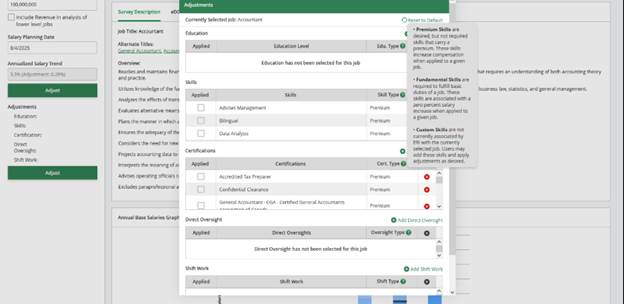
Figure 2. Using the Adjustments tool in ERI SalaryExpert’s Salary Assessor, users can apply pay premiums for education, skills, certifications, direct oversight, and shift work.
Interested in optimizing the way you manage compensation? Click here for a free demo.