Understanding Your Compensation Metrics
Numbers are not without meaning. HR and compensation professionals know for a fact that understanding what compensation metrics represent is a fundamental aspect of strategic and effective compensation management. More than that, interpreting compensation metrics accurately and insightfully allows HR and compensation professionals to evaluate and understand the effectiveness of their compensation strategy and administer the correct adjustments when necessary.
Using current and accurate data, compensation metrics offer HR and compensation professionals an efficient and fruitful way to analyze internal compensation frameworks, such as salary structures, and ultimately align them with an organization’s philosophy or goals. Beyond compensation alignment, HR and compensation professionals utilize these metrics to meet various objectives at an organization, such as fair pay, budget alignment, and salary structure development.
What Are Compensation Metrics?
Compensation metrics are a key cornerstone of compensation management that enable HR professionals to effectively identify, measure, and analyze the impact of existing and planned pay practices in an organization. HR teams employ compensation metrics to monitor the extent to which their organization’s compensation practices and policies align with not only the market but also the organization’s budget and pay strategy.
Here are some common purposes for the utilization of HR and compensation metrics:
- Create effective salary structures: Salary structures are the core of an organization’s compensation strategy. With effective metrics in place, HR and compensation professionals can create and maintain more accurate and strategic pay ranges or bands based on current market data.
- Control costs: Organizations create fixed budgets, making it important for HR and compensation teams to not only stay within budget but also ensure fair and competitive compensation across the organization. Compensation metrics help HR and compensation analysts maintain effective compensation practices while staying mindful of an established budget.
- Measure the success of your organization’s compensation strategy: Compensation metrics are a reliable way to gauge the effectiveness of an organization’s pay practices and policies. When HR and compensation analysts track these metrics consistently, they can measure the performance of existing pay practices, creating the data-driven foundation for solutions to any issues that may arise.
Tracking compensation metrics is an essential aspect of compensation management, but which compensation metrics prove to be the most valuable in compensation analytics?
How to Track Compensation Using Metrics
Although far from representing the entirety of compensation metrics, the following are a few of the more common and essential compensation metrics that HR and compensation professionals encounter when analyzing pay:
Compa Ratio
Represented as a ratio, the compa ratio is the relationship of base pay to the pay grade midpoint. It is calculated by dividing the actual base pay by the midpoint of the corresponding pay range, as expressed in this form formula:
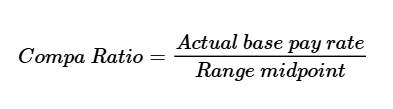
The midpoint of the pay range usually represents the market value within the context of an organization’s compensation strategy or philosophy. With that said, it becomes crucial for HR teams to periodically review (and update when necessary) an organization’s internal salary ranges and midpoints to align with market changes. Additionally, the compa ratio can be used to assess an employee’s progression within a specific salary band, as well as evaluate the competitiveness of an organization’s compensation plan against market data.
The target compa ratio value varies from organization to organization, although, in general, organizations often target a compa ratio value of 1 (for a 1:1 relationship with the midpoint). For example, let’s say a pay grade is defined with a minimum of $41,250, a midpoint of $55,000, and a maximum of $68,750, annually. If the employee’s salary is $55,000, then their compa ratio is 1, and the organization is on target. However, if the employee’s salary is $44,000, then their compa ratio is 0.8, and the organization may plan on adjusting their salary according to their philosophy and goals for the position and employee.
Comp ratio is also used as a critical metric in the design and administration of salary increases. To meet this end, subscribers to ERI's Salary Assessor can use the Total Rewards feature in Compensation Management to plan salary increases based on employee performance, compa ratio, or market index, with results summarized in reports easily downloaded from the platform.
Market Index
The market index is the comparison of an organization’s internal pay to the mean or other percentile of market salary values. While HR and compensation professionals use compa ratio to compare the base salary to an internal pay range midpoint, the market index is used to compare the base salary to the external marketplace. The market index is calculated using the following formula:
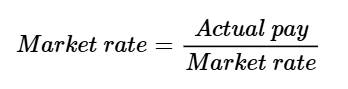
Represented by a ratio that compares salaries to a market reference point, the market index is ultimately utilized to track how an organization’s salary structure compares to that of the market, assisting HR and compensation experts in planning. For instance, with market index metrics, HR teams can choose to lead, lag, or lead-lag the market to support a long-term compensation strategy. This is especially useful to assess the effectiveness of an organization’s compensation practices in maintaining competitiveness amid changing market conditions.
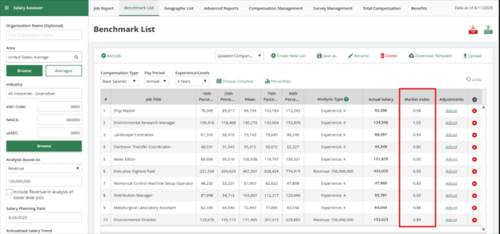
Figure 1. In ERI SalaryExpert’s Salary Assessor, users can easily calculate the market index for various jobs at once in the Benchmark List.
Salary Range
The salary range, also known as the pay range, is a compensation metric typically used to determine employee pay.
The salary range refers to a range of rates, from the minimum to the maximum, for a particular class or grade of jobs/employees. A salary range would consist of the following:
- Minimum – the lowest rate for a job or group of jobs, often the entry hire rate
- Midpoint – the competitive market rate, target, or control point*
- Maximum – the highest rate that the organization is willing to pay for the job
* When a company needs to set the midpoint of a range at a different rate than the market, this is often called the “control point.”
As mentioned, the salary range is used to set employee compensation and, as such, is an integral part of an organization’s salary structure. Through an established salary range within the salary structure, HR and compensation analysts can identify other important metrics useful for analysis, including salary range penetration (an employee’s pay progression within their salary band), discussed below, and salary range spread (the percent difference between the minimum and maximum). Beyond that, tracking this metric helps a company retain a highly skilled workforce, control organizational costs, and remain market competitive.
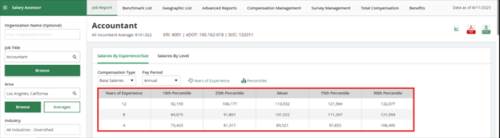
Figure 2. Using the Job Report in ERI SalaryExpert’s Salary Assessor, subscribers can access a specific job’s market-based salary range, determined by years of experience or organization size, industry, and location, to create accurate salary structures and set pay.
Range Penetration
The range penetration is a compensation metric that shows where an employee’s salary falls within their pay range. Like compa ratio, range penetration provides a clear view into where an employee’s pay falls within a salary band, offering insight into their pay progression and potential career growth within the pay band. Salary range penetration is particularly useful for HR and compensation analysts when planning pay increases, as it helps ensure that salaries are appropriately positioned within their salary ranges and supports alignment with organization pay objectives. Range penetration is calculated using the minimum and maximum of a salary range, as shown below:

Range penetration is occasionally used as an alternative to compa ratio as it provides a percentage, from 0% (minimum) to 100% (maximum), to demonstrate how far into the range an employee’s salary has penetrated. For example, if the range penetration is 50%, then the employee would be paid at the midpoint of their salary range.
How ERI SalaryExpert Helps Compensation Experts Track Metrics
Tracking HR and compensation metrics is an integral part of sound compensation management. The compensation metrics discussed above are integrated in ERI’s Assessor Series, making our platform the ultimate compensation management solution to help you bridge analytics with compensation strategy. Try a free demo today to start using essential compensation metrics for effective benchmarking and comprehensive compensation management in your organization!